
The general theory of verbal humour (GTVH) is a theory which attempts to explain how a joke works and why it is funny. The theory only refers to ‘verbal’ humour and not other forms such as slapstick comedy. The basic postulate of the theory is that humour is produced through the sudden resolution of an incongruity which has been set up in the telling of the joke. Laughter then is just the realisation of this incongruity.
“The cause of laughter in every case is simply the sudden perception of the incongruity between a concept and the real objects which have been thought through it in some relation, and laughter itself is just the expression of this incongruity.” (Schopenhauer 1883: quoted in Ritchie 2004 )
A verbal joke consists of a setup, where the incongruity is developed (but hidden from the audience) and the punchline where the incongruity is revealed. Laughter is the resolution of this incongruity. Even if we don’t physically laugh at the joke, we intuitively know whether the verbal setup and punchline could be classified as a joke.
For example, in the very simple joke, the setup (or jab line) asks the question ‘what is grey, has four legs, and a trunk’. The audience is asked to think about this and would probably guess the unmarked answer ‘an elephant’.
What is grey, has four legs, and a trunk?
A mouse on vacation
However in the punchline that follows, the incongruity is completed. It is not an elephant, but a ‘mouse on vacation’. This creates an incongruity because mice don’t normally take vacations. However this incongruity is resolved when we realise that ‘trunk’ can have a second meaning of ‘luggage’. Laughter is a result of the mind discovering (resolving) this incongruity. (Note that if in the second line we had simply said ‘elephant’ then no incongruity would have been set up and this would not be termed a joke. )
The main idea of the GTVH extends the notion of incongruity and considers six knowledge resources which all jokes possess. Ritchie lists these as the following:
(1) Script opposition (SO): a text must be interpretable as two ‘opposing’ scripts
(2) Logical mechanism (LM): the logical mechanism ‘accounts for the way in which the two senses (scripts) in the joke are brought together’
(3) Situation (SI): the situation of a joke is, informally speaking, the setting, in terms of characters, objects, location, etc. described in the text.
(4) Target (TA): the target of a joke is what might be known informally as the ‘butt’; that is, the person, group or entity which is being ridiculed, attacked or presented in a negative light.
(5) Narrative strategy (NS): the NS is a broad classification of the linguistic structure or style for presenting the joke.
(6) Language (LA): this source supplies the actual linguistic units (words, etc.) used in the text. (Ritchie 2004)
Analysis of a Joke
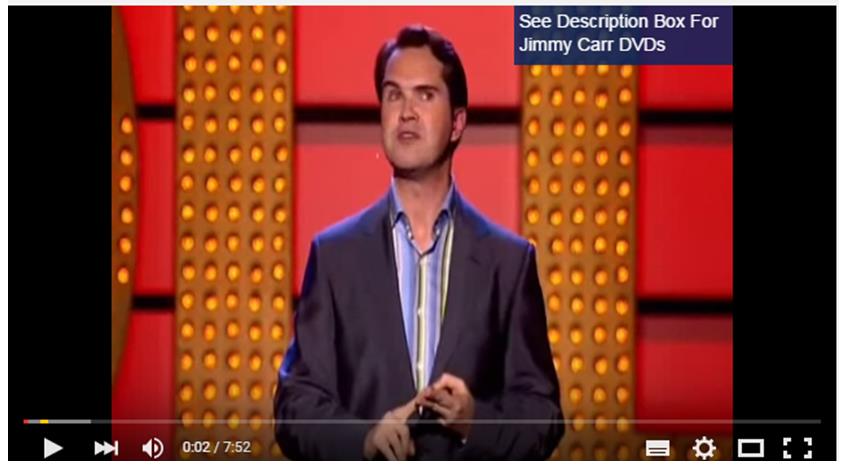
Consider the following verbal humour from Jimmy Carr, a British stand-up comedian. The humour can be watched on YouTube (at 50 secs) at the following: https://youtu.be/XERVHG5726Y?t=50s
1. It sounds like I’m misogynistic but I’m not
2. I’m actually quite a modern man (.)
3. I’ve got no problems buying tampons (.)
4. But apparently they’re not a >proper present< ((NVC))
        ((laughter))
5. Happy birthday mum (.)
        ((laughter))
6. It says super on the box (.)
7. I don’t know what you want
        ((laughter))
Carr sets up the joke by claiming to be a ‘modern man’ and not at all ‘misogynistic’. However an incongruity is revealed at line 4 when it becomes clear that he is buying tampons as a present rather than a day-to-day item. A nonverbal gesture accompanies the incongruity at line 4 to emphasise this. The audience then laugh as the incongruity of line 4 with the previous script is realised and resolved. The phrasing of line 4 suggests that Carr has already made the mistake of buying tampons as a present which further adds to the humour.
Carr continues the joke at line 5 when he reveals he is buying the present not for a girlfriend but for his mother. Lines 6 and 7 further extend the joke when he reveals that he has misinterpreted the word ‘super’ on the box in 6 and when he further reveals his lack of knowledge of tampons and presents in 7.
Using the six knowledge resources from Ritchie (2004) above we can analyse the features of this joke.
SO: buying day-to-day items vs buying presents (being modern vs being misogynistic)
LM: garden-path
SI: a man buying items for a female
TA: himself
NS: narrative
LA: English
Script opposition, at one level, is the action of buying day-to-day items against buying a present and the social conventions this involves. Carr setups up the script to be one of buying a simple daily items but then reveals an incongruity in 4 when he indicates he is actually buying a present. At a higher level, the script opposition can also be thought of as one of ‘being modern’ versus ‘being misogynistic’.
The logical mechanism (LM) is the rhetorical device for how the incongruity is revealed. There are many types of mechanism employed by jokes and the theory behind these is quite detailed. For this joke we will classify it as ‘garden-path’.
The situation (SI) of the joke is a man buying items for a female. No other contextual information is given although more can be inferred from the video such the fact that he comedian is a British stand-up comedian.
The target (TA) of the joke, or the ‘butt’ of the joke, can be considered the comedian himself. He is inviting the audience to laugh at his own lack of understanding of female needs through the revelation that he believes tampons can be given as birthday presents. He is also knocking down the image of himself as a ‘modern man’ and reversing the initial disclaimer that he is not ‘misogynistic’. Carr often does jokes in which the target is the female population but in this case the joke is on himself.
The narrative style (NS) is this case is simply ‘narrative’ in that Carr tells the joke as a story about his own life. The language used (LA) is British English.
The GTVH states that each joke can be analysed in this way with six knowledge resources. Prosody and non-verbal gestures also play their part in determining whether the joke is perceived as being funny.
References
Carr, J (2011) Jimmy Carr Live At The Apollo Part 2. YouTube. https://youtu.be/XERVHG5726Y
Ritchie, G (2004) The Linguistic Analysis of Jokes . Routledge

Leave a Reply
You must be logged in to post a comment.